
On Crypto and Greed
Thinking about collectibles, empty suits, leverage, crowds, and the sin of greed, plus an advertisement for my book on money and finance.

“Crypto investors love leverage,” said Ryan Rasmussen, head of research at Bitwise Asset Management. “What we see time and time again is that traders get out over their skis. They think this time is different.” – From the Financial Times (“Crypto market sheds $1.2tn as traders shun speculative assets”, 18 Nov 2025)
Once upon a time, in what now seems like another life, I advised investors not to buy Bitcoin, because it was doomed. For people who want to become richer without doing any work or providing anything of value to the world (a group who are misleadingly called financial investors), the recommendation was terrible. My last reiteration of the asset’s impending disappearance came when the collectible (like fine art except without either the fine or the art) was selling at $10,000 a unit. As of this morning, a bitcoin can be yours for about $90,000.
I am happy to say that I no longer have to think about crypto currencies. No longer am I mocked on Twitter for my inability to appreciate just how much people would pay to own a few shreds of the emperor’s latest, greatest, computer-tailored new outfit. And with the wisdom of age, I now realise that no little boy may ever come along to change the hysteria of buying into one of selling. Perhaps these computerised nothings will join old comic books and century old-bric-a-brac as “collectibles”, which are useless, but worth something simply because people think they are worth something. I still think that is unlikely, since at least it is impossible to make more old comic books and the like, while new crypto things can be made as fast as there is real money (a very useful trust-based thing) to buy them. Surely, my remaining shards of belief in crowd rationality declares, there will come a time when supply overwhelms demand and the price will collapse.
In the last month or so, there has been a mini-collapse. The Financial Times article (as quoted above) attributes the speed of the decline to the use of leverage by so-called investors in crypto (gamblers would be a more accurate description). For any readers who are sufficiently blessed not to know what leverage is, the term refers to paying for things with borrowed money. Speculators (another word for this sort of gamblers) like leverage, because it can increase the gains, relative to paying with their own money, when the price of a thing goes up. Leverage also increases the losses when the price decline.
The desperate desire of leveraged buyers to limit their losses by selling out explains why prices fall rapidly. The resulting surplus of sellers over buyers is supposed to be corrected by lower prices (that is the logic of markets in economic theory), but falling prices tend to reduce the supply of buyers, which leads to falling prices, which leads to more sellers, which…
I make no predictions. My only observation is that the desire to buy crypto is a greedy desire. There is no reason to buy other than the craving for monetary gains which have no moral justification. That is almost a definition of greed. (I know that there are flimsy arguments about the possible use of bitcoin and the like as a currency for government-escaping activities, most notably organised crime, but they are risible.) So, crypto is bad for the soul of the buyer, serves no good economic, social, or political purpose, and – readers will have to take my word for this – the rapid price changes add various sorts of instability to a monetarily overburdened financial system.
There is no word for what happens when greed is leveraged, but perhaps using borrowed money to pay for crypto things could be called hyper-greed. You might think or hope that the political-regulatory authorities or the social consensus would be determined to ban, or at least to limit, manifestations of hyper-greed.
But if you are thinking or hoping that, you do not understand what I consider to be the fundamental flaw of finance: the endorsement of greed. While there are attempts to limit greed in much of the economy, often half-hearted but nonetheless present and somewhat effective attempts, in finance greed is tolerated when it is not positively embraced. The economic costs of the social sin of financial greed can be significant and any economic benefits are extremely limited. However, that practical calculation is morally irrelevant. The key moral truth is that greed is bad for the greedy, even when it does no economic harm.

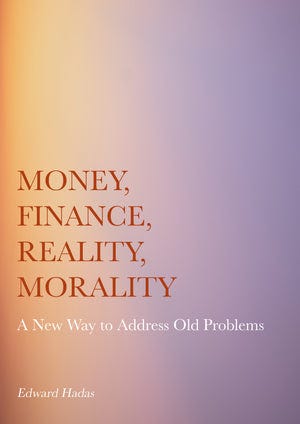
I write this little essay solely to remind readers that the nature, tolerance, and danger of financial greed are explored (along with many other things) in my book on money and finance, published by Ethics Press in 2022 and now translated into Chinese.
I just hope the LLM thing fails massively before it does grievous damage. I fear that the AI-induced stupidifation which has already started will be hard to reverse.
Hi. Well said re crypto. What say you about AI? Tedi Siminowsky